Biocarst develops biotechnology to integrate environmental protection and land restoration in a single, scalable process.
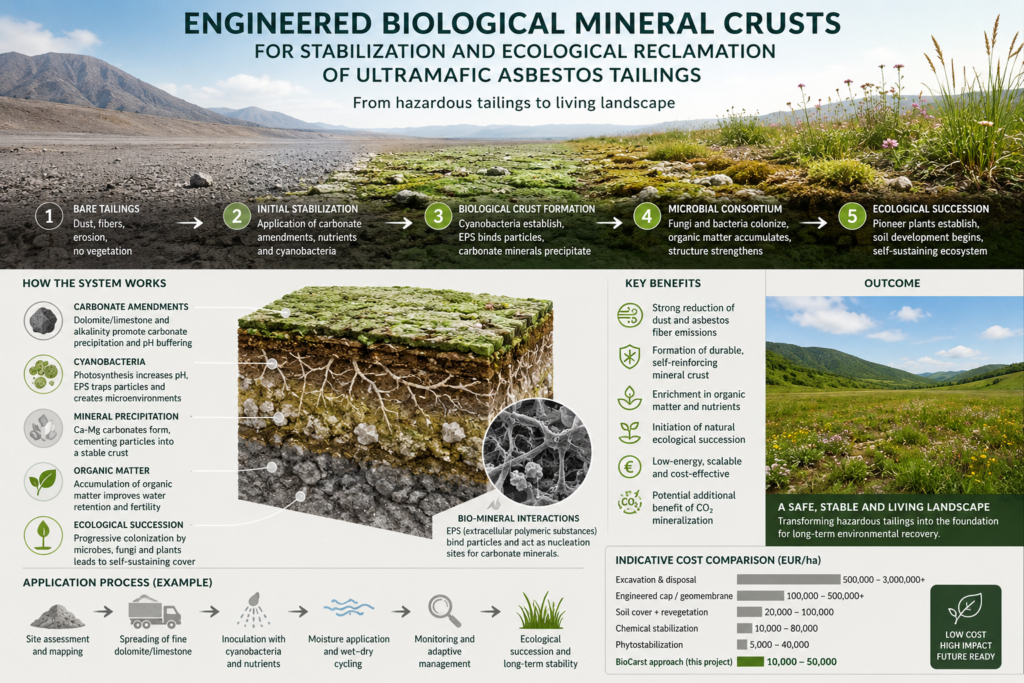
Environmental Protection
Mine tailings, especially those containing asbestos, pose a long-term risk to nearby communities.
Biocarst addresses this by microbially mediated forming of carbonate binding phases that:
- Stabilize fine particles
- Reduce dust emissions
- Prevent the spread of hazardous fibers
This leads to improved air quality and reduced health risks.
Land Restoration
Biocarst initiates natural ecosystem recovery.
Microalgae form a thin biological layer that contributes organic matter and creates conditions for the gradual establishment of vegetation and soil development. Conventional phytostabilization does not work on ultramafic tailings due to alkaline environment poor in nutrients.
Biocarst process establishes fertile environemnt on ultramafic tailings step by step, enabling ecological succession and growth of plants at the final stage.
Over time, tailings are transformed from unstable waste into stable, biologically active surfaces.
Climate Impact
Biocarst captures CO₂ from the atmosphere and converts it into stable mineral carbonates.
Unlike conventional approaches, this form of storage is permanent, with no risk of re-release.
Key Advantages
Dual impact in one system
Biocarst combines CO₂ removal with environmental remediation, eliminating the need for separate solutions.
Low-cost and low-energy
The process is powered by sunlight and uses simple infrastructure, avoiding energy-intensive technologies.
Scalable and deployable
The system can be applied directly to large tailings areas using standard industrial methods such as spraying.
Uses existing resources
No new raw materials are required—Biocarst uses mine waste as a reactor for carbon capture.
Permanent and measurable results
CO₂ is stored in mineral form, enabling quantifiable and verifiable climate impact.